
Should You Get Tested?
When it comes to giftedness there is still no consensus within the scientific community on what giftedness exactly is and no universally accepted definition of giftedness.
This makes it more difficult to determine whether someone is gifted.
Because above-average intelligence is one of the few aspects of giftedness that most experts agree on, in most countries, an IQ test remains the primary tool for the formal identification of giftedness.
However, as we will address in this article, this does not always capture the full picture of giftedness.
In this article, we will discuss:
- The role that intelligence plays in giftedness.
- The limitations of common IQ tests when it comes to identifying giftedness.
- Should you get tested - and why?
- Things to keep in mind when you're planning on taking an IQ test.

The Role That Intelligence Plays In Giftedness
Giftedness encompasses a wide range of characteristics and traits, which can be expressed slightly differently in each gifted individual.
This can sometimes make it difficult to identify yourself as gifted. After all, there will almost always be a few characteristics that you do not strongly relate to.
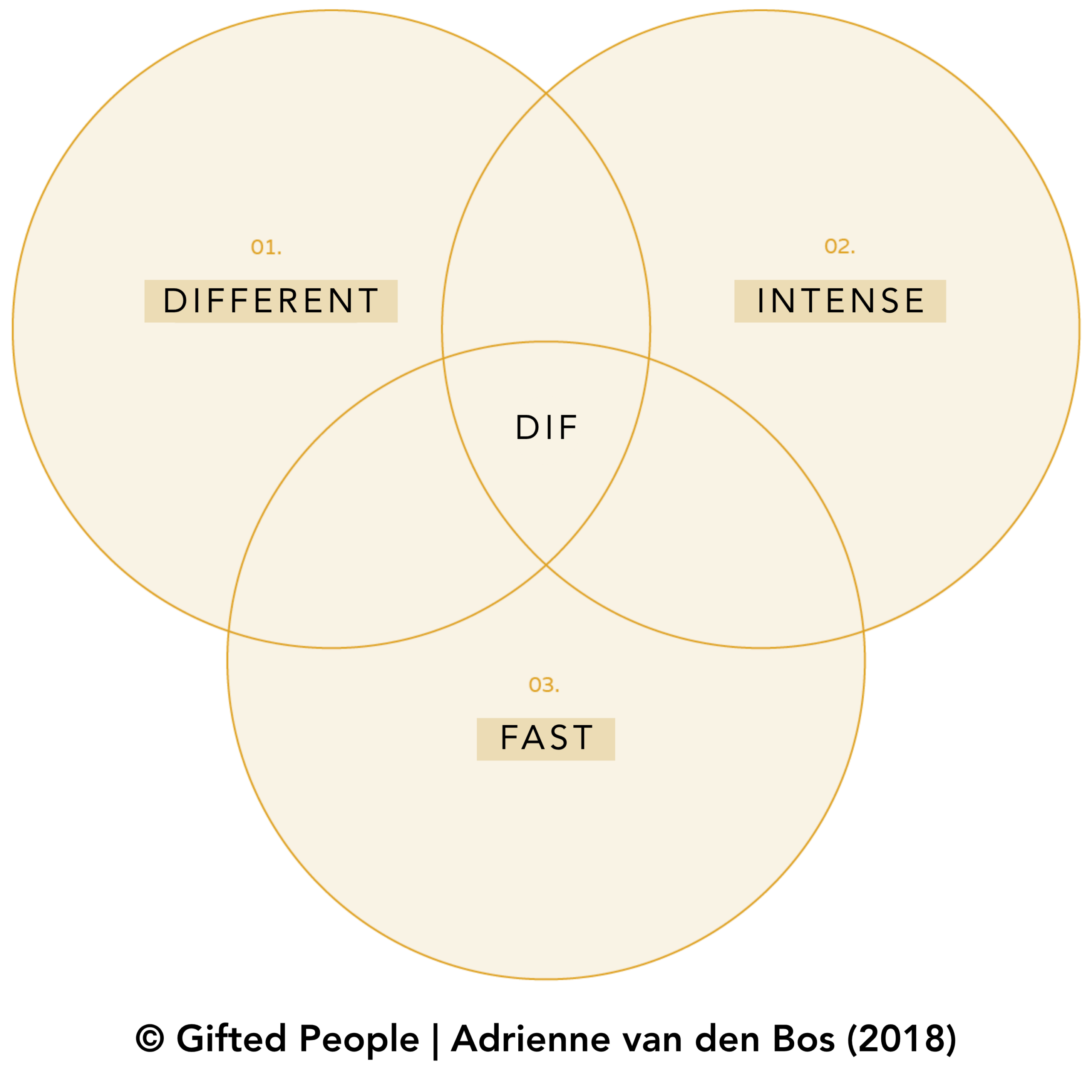
That is why, at Gifted People, we use the DIF Model to explain giftedness.
DIF refers to the three main characteristics of giftedness: (1) Different, (2) Intense, and (3) Fast.
You can read more about these main characteristics in this article: 'What Is Giftedness?'
Although the specific characteristics may vary from one gifted individual to another, within the DIF Model, these three core characteristics form the foundation of giftedness.
Part of the characteristic Fast is above-average intelligence. This is typically reflected in an IQ score around 130. In other words, it does not necessarily have to be a precise score of 130 or higher, but rather a score in the region of 130.
It's important to note that intelligence is not the same as achieving high results in school or at work. Performance is also influenced by factors such as your environment and the extent to which that environment is a good fit for you.
Being intelligent also doesn't mean that you always do everything well, are successful in everything you do, or excel at everything. You can be gifted and still struggle with language or mathematics. And yes, you can also be gifted and occasionally do something “stupid” ;).
The Limitations Of Common IQ tests When It Comes To Identifying Giftedness.
The question of whether you are actually smart enough to be gifted causes many gifted individuals to remain in doubt for a long time. For some, taking an IQ test provides clarity. An IQ test can offer insight into the intelligence component of giftedness.
It's important to note that an intelligence test is currently the only way to formally identify giftedness. However, there is an important nuance to keep in mind: having above-average intelligence does not necessarily mean that this will always be reflected in an IQ test score.
An IQ test is a snapshot in time and can be influenced by factors such as stress, motivation, fatigue, distractions, underachievement, and test anxiety. An IQ test also does not measure every form of intelligence.
When an IQ test results in a score around 130, giftedness can be formally confirmed. However, an IQ score below 130 does not automatically rule out giftedness.
Because giftedness is not considered a disorder, we speak of identifying or confirming giftedness rather than diagnosing it. This also means that there is no requirement to have your giftedness formally identified.
Should You Get Tested - And Why?
Before deciding whether or not to take an IQ test, it may be helpful to ask yourself why you want to get tested in the first place.
For some people, a test provides clarity and confirmation. Others hope it will help them better understand themselves or explain experiences they have had throughout their lives.
You may also have practical reasons for wanting to get tested, such as work, education, coaching, or personal development.
At the same time, it is important to realize that an IQ test is not always necessary to move forward in your giftedness journey.
For many people, learning more about giftedness, recognizing themselves in the characteristics, and gaining a deeper understanding of how giftedness shows up in their lives already provides valuable insights and direction.
Ultimately, the question is not only whether you are gifted, but also how understanding giftedness can help you better understand yourself.
Things To Keep In Mind When You're Planning to Take an IQ Test
If you decide that taking an IQ test is right for you, please keep the following in mind:
- Always choose a psychologist or specialist who has experience assessing (potentially) gifted adults.
- If your IQ test does not indicate above-average intelligence, do not automatically rule out giftedness. Giftedness may still be relevant for you.
- An IQ test is a snapshot in time. Factors such as stress, fatigue, motivation, underachievement, test anxiety, and distractions can influence the result.
- An IQ test measures an important aspect of giftedness, but it does not capture the full picture of giftedness.
- A test result can provide clarity, but it does not determine your value, potential, or what is possible for you in life.
If you want to learn more about Giftedness
Request our free e-book 'Giftedness: It's More Than You Think'.