Giftedness: What It Is and How to Recognise It
Approximately 2.5% of the population is gifted.
Giftedness is a broad term that still causes a lot of confusion, as there is no single, clear scientific definition.
In reality, giftedness cannot be captured in just one explanation. There is a great deal of diversity among gifted individuals.
Therefore, there is no such thing as THE gifted person, and one gifted individual can be very different from another. Even between siblings, giftedness can express itself in very different ways
In addition, the environment plays a role in the extent to which certain characteristics of giftedness become visible and can develop.
Although there is no single definition, there is overlap between the most commonly used definitions.
One of these overlaps is the presence of high or above-average intelligence. However, giftedness is more than that. You can discover more about this on this page.

What Are the Three Main Characteristics of Giftedness?
Broadly speaking, giftedness is a combination of characteristics that have a distinctive impact on your life path and on the way you experience and perceive the world around you.
Giftedness is more than a collection of individual traits. It is primarily the combination of certain characteristics that together form an essential part of who you are as a person.
Recognizing yourself in a few individual characteristics, such as perfectionism or above-average sensitivity, does not automatically mean that you are gifted.
At the same time, you are unlikely to recognize yourself in every characteristic associated with giftedness.
Some characteristics of gifted individuals may be less applicable to you or may have been expressed less strongly because of the environment in which you currently function or have functioned in the past.
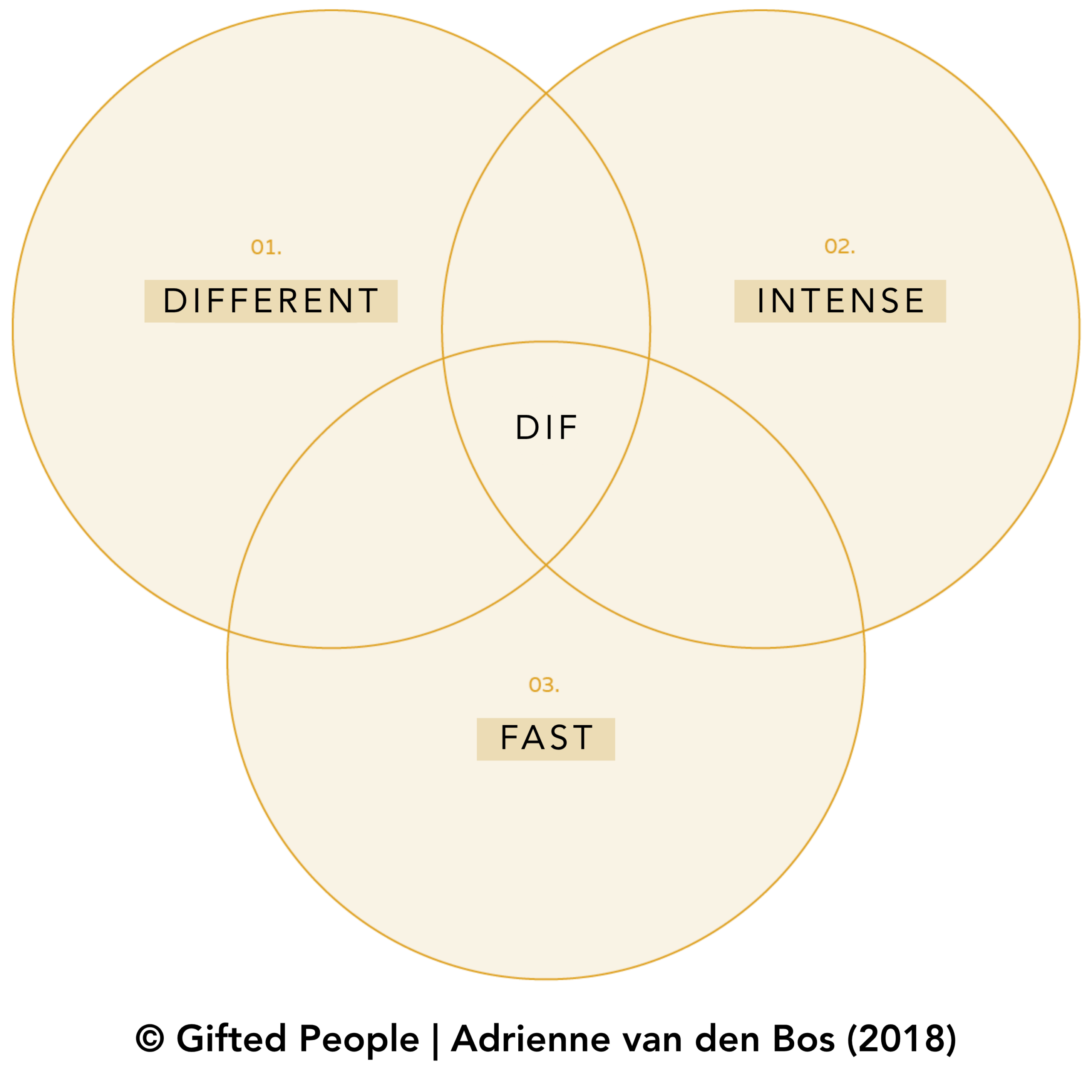
Despite the diversity among gifted individuals, there are three main characteristics of giftedness that together form the overall picture.
These three characteristics are: (1) Different, (2) Intense, and (3) Fast.
Main Characteristic 1: Different
As a gifted person, you are fundamentally wired differently. You feel differently, see things differently, and approach life differently.
Although it is possible to be gifted without it ever being formally recognized or identified, you will usually notice it yourself. From an early age, gifted individuals often experience a deep sense of being different.
While this feeling may be very clear internally, it can be surprisingly difficult to explain exactly what makes you different or to put it into words.
Feeling different can sometimes feel as though you are an alien in this world. It can feel as though you were born in the wrong place or even in the wrong time.
Because of this sense of difference, it is often more challenging to connect with most people around you, especially when you have few like-minded individuals in your environment.
The feeling of being different is usually strongest in environments where you encounter few or no like-minded people. If you grew up in an environment with enough people who were similar to you, this feeling may be much less pronounced or perhaps hardly noticeable at all.
Being different means that you see the world differently and approach it from a different perspective. You notice things that others do not see, or you see them in a different way. At the same time, what seems perfectly logical to you may not seem logical or obvious to others, which can lead to misunderstanding and miscommunication.
When you are consistently the person who sees things differently, you may eventually begin to doubt yourself—especially when people point out that they do not see what you see, or suggest that your perspective is unusual.
Because you see things differently and arrive at different conclusions, you also tend to act differently. For example, you may interpret questions, instructions, explanations, and agreements differently, causing you to unintentionally do things that were not expected—or fail to do things that were.
When you have found a place in society that truly fits who you are, you will be better able to recognize and make use of the strengths that come with being different. After all, you possess the ability to think outside the box, to see what others miss, and to arrive at original insights and solutions that are not immediately obvious to others.
Main Characteristic 2: Intense
Being different is closely connected to the second main characteristic: Intense. As a gifted person, you are intense in the way you think, feel, experience, and engage with the world around you.
Because of this intensity, other people may experience you as intense. As a result, gifted individuals are often described as being a little bit “too much.”
For example, people may describe you as too energetic, too emotional, too dreamy, too sensitive, too opinionated, too critical, too perfectionistic, or too complicated. You will probably recognise immediately which version of “too” you have been called at some point in your life.
Gifted individuals are often confronted with these labels. Others may say things like:
"You're overreacting."
"Why do you always make things so complicated?"
"Why do you take everything so personally?"
or
"You always think you know better."
When you are frequently told that you are “too much,” it can be a sign that you are functioning in an environment where there is little room for your natural energy, enthusiasm, and way of being.
As a result, many gifted individuals begin to hold themselves back. They start suppressing parts of who they are and gradually create a life that is out of alignment with their natural way of functioning. Living against your own nature requires a tremendous amount of energy.
At the same time, it is precisely this intensity—these very qualities that others may describe as “too much”—that make you who you are.
Your intensity enables you to care deeply, think deeply, feel deeply, and engage wholeheartedly with the things that matter to you. It is often the source of your passion, your creativity, your drive, your idealism, and your desire to contribute something meaningful.
That is why it is so important to get to know yourself. To understand who you are, what you want, what you need, and what you are capable of. We at Gifted People call this your unique and Personal Blueprint.
When you live in alignment with your Blueprint, you become better able to find or create environments in which your intensity is not only accepted, but also valued and put to good use.
A second aspect of the characteristic Intense is that gifted individuals often have a heightened sensitivity to certain stimuli, while also having a stronger desire for specific kinds of stimulation.
As a gifted person, you may experience certain impressions, emotions, thoughts, or situations more intensely than the average person. Things that others barely notice may have a significant impact on you.
At the same time, you may also have a stronger need for depth, challenge, meaning, beauty, learning, connection, creativity, or other forms of stimulation that are important to you. This combination can create both challenges and opportunities.
When your environment does not provide the stimulation you need, you may feel restless, frustrated, bored, or disconnected. When you are exposed to too much stimulation, you may become overwhelmed, exhausted, or overstimulated.
However, when you understand what energizes you, what drains you, and what your unique needs are, your sensitivity and intensity can become valuable strengths rather than burdens.
Many gifted individuals discover that understanding and embracing their intensity is one of the most important steps in learning how to thrive as a gifted person.
Main Characteristic 3: Fast
An important aspect of this characteristic is the above-average intelligence. It is important to note here that there are different forms of intelligence and that having above-average intelligence does not necessarily mean that you always achieved high grades in school.
In addition to above-average intelligence, gifted individuals often develop ahead of their peers in certain areas. As children, they may learn some skills earlier than other children. They may start reading or talking at a younger age, or they may develop these skills later but seem to master them almost immediately.
Gifted children often grasp new concepts quickly, require less repetition, and learn new skills with relative ease. As a result, many gifted adults can look back on their school years and recognise that they frequently spent more time waiting for their classmates to catch up than being challenged themselves.
Characteristics such as perfectionism, a strong memory, and an endless stream of "why" questions can also become visible at a young age.
At the same time, it is important to understand that a developmental advantage in one area does not automatically mean being ahead in every area. A gifted child may be far ahead intellectually while developing at an average pace socially or emotionally.
As an adult, this characteristic often becomes visible in a different way. Many gifted adults experience that they are regularly several steps ahead of the people around them. They can already see opportunities, risks, patterns, or solutions while others are still trying to understand the situation itself.
This can sometimes be frustrating. You may feel as though you are constantly waiting for others to catch up, while others may feel that you are moving too quickly or skipping important steps.
The characteristic Fast also refers to the speed at which your mind processes information. This does not necessarily mean that you always respond quickly. Rather, it means that your internal thought processes often move rapidly. Ideas, insights, associations, and connections follow one another at a high pace, allowing you to see patterns, understand complex situations, and connect seemingly unrelated pieces of information with ease.
Because you learn quickly and often have a strong need for intellectual stimulation, you may also lose interest more quickly than average when something no longer challenges you. As a result, you may become bored with certain tasks, jobs, hobbies, projects, or even relationships sooner than the people around you.
For many gifted individuals, this can be a significant source of frustration. Often, however, the frustration does not come from becoming bored itself, but from the belief that becoming bored is somehow wrong. Many of us have learned that we should make a choice and stick with it indefinitely. Yet for gifted individuals, growth, exploration, and continued development are often essential needs rather than optional luxuries.
This is why having a clear understanding of your Personal Blueprint is so important. Because when you understand what truly fits who you are and what aligns with your path, you can continue taking meaningful next steps that build upon one another. Instead of moving sideways from one unrelated thing to the next, you move forward in a direction that allows you to keep growing, developing your skills, and finding the level of challenge and stimulation you need.
In doing so, you will also increase the likelihood of finding work, interests, and pursuits that can continue to engage and inspire you over the long term.
If you want to learn more about Giftedness
Request our free e-book 'Giftedness: It's More Than You Think'.